

Housing Design Climate Report
by Kandarp Rajyaguru, Placepoet Architects
The weather of a place is the state of the atmospheric environment over a brief period. Integrated weather over several years is climate, or more specifically the macro-climate. Analysing the climate of a region shows when people are likely to be comfortable or uncomfortable, and which climatic elements cause the discomfort. That information helps a designer filter adverse effects while allowing those that are beneficial. Discomfort — and the energy demand of mechanical systems — can be reduced by judicious control of climate. Built form and openings can be derived from this analysis.
This report reviews climatic factors, India’s climate zones, design implications for each zone, and a short reading of Jodhpur as a hot-and-dry example. It was prepared as a graduate report at SVNIT Surat (M.Tech Urban Planning, 2016–17), guided by Dr. Chetan Patel.
Factors affecting climate
Weather and climate are characterised by:
- Solar radiation
- Ambient temperature
- Air humidity
- Precipitation
- Wind
- Sky condition
Solar radiation
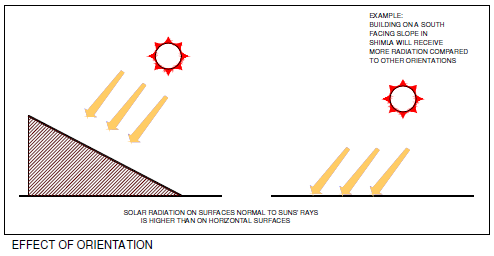
Solar radiation is the radiant energy received from the sun — intensity per unit time per unit area, usually in W/m². Incident radiation varies with latitude and longitude, orientation, season, time of day, and atmosphere. It is the weather variable that most determines whether a place is hot or predominantly cold. Instruments include the pyranometer and pyrheliometer; sunshine duration is measured with a sunshine recorder.
Ambient temperature
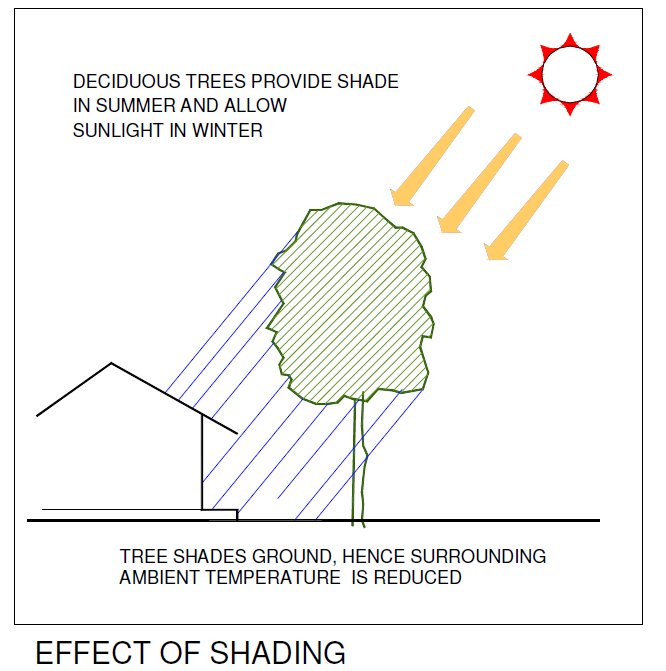
Ambient temperature is the temperature of air in a shaded but well-ventilated enclosure, expressed in °C. It depends on wind and local factors such as shading, water bodies, and sun. When wind speed is low, local factors strongly influence air close to the ground. With higher wind speeds, incoming air is less affected.
Air humidity
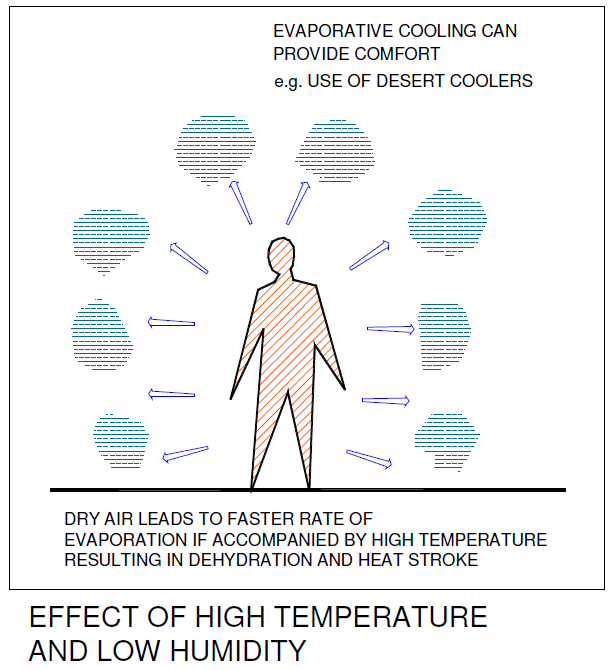
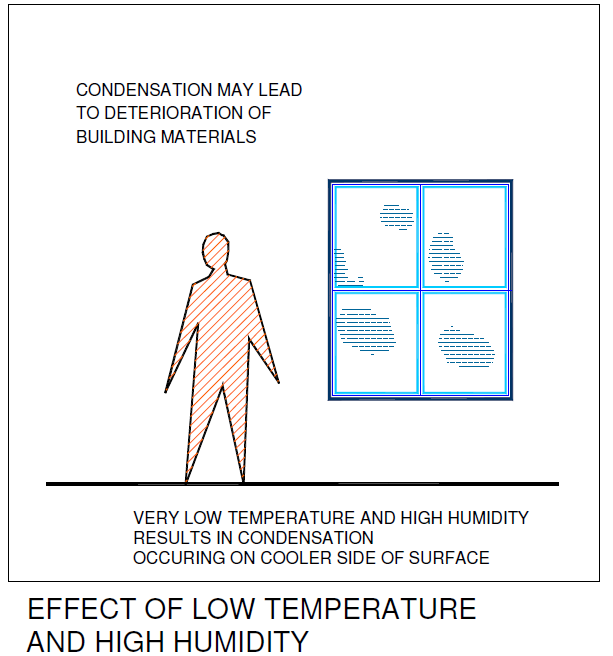
Humidity is usually expressed as relative humidity: the ratio of the mass of water vapour in a volume of moist air to the mass in the same volume of saturated air at the same temperature. It tends to be highest close to dawn and falls as temperature rises; the midday drop is largest in summer. High humidity reduces transmission of solar radiation through absorption and scattering, and reduces evaporation of water and sweat. High humidity with high temperature causes particular discomfort.
Precipitation
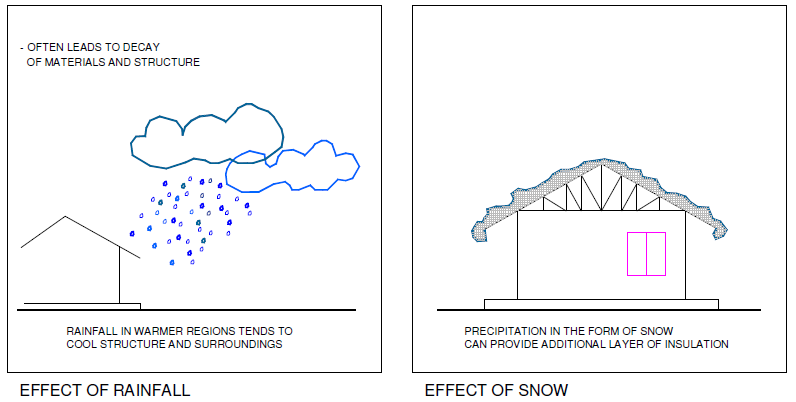
Precipitation includes rain, snow, hail, and dew, usually measured in millimetres with a rain gauge.
Wind
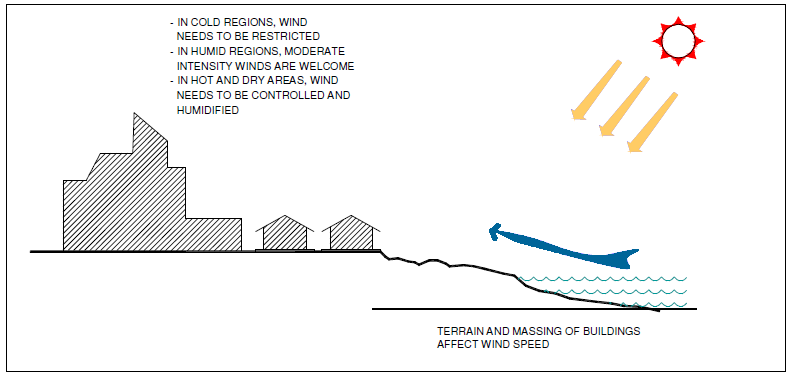
Wind is air movement due to differences in atmospheric pressure, caused by differential heating of land and water and by the Earth’s rotation. Speed is measured with an anemometer (m/s). It is a major design consideration because it affects indoor comfort through convective heat exchange and infiltration.
Sky conditions
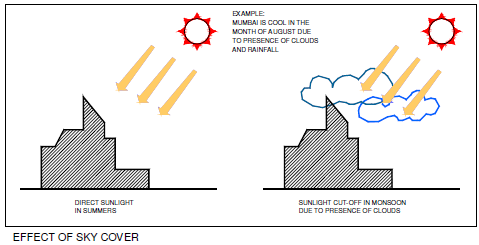
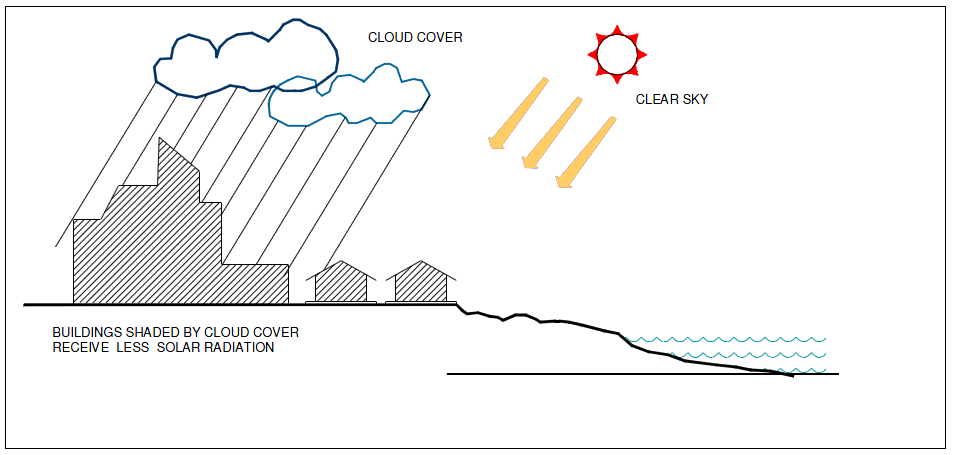
Sky condition generally means cloud cover or sunshine duration. Under clear skies, solar intensity increases; in monsoon it reduces. Re-radiation losses from external surfaces are greater toward clear skies than covered skies.
Climatic zones of India
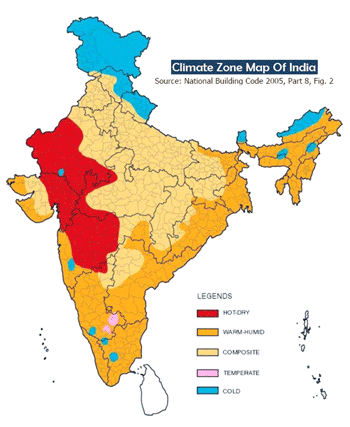
Regions with similar climate are grouped into zones. On the factors above, India can be divided into:
- Hot and dry
- Warm and humid
- Moderate
- Cold and cloudy
- Cold and sunny
- Composite
Implications of climate on building design
Comfort requirements vary by zone. ASHRAE defines thermal comfort as “that condition of mind which expresses satisfaction with the thermal environment,” and as the range in which a majority of people would not feel heat or cold. In still air that zone corresponds to about 20–30 °C dry bulb with 30–60% relative humidity. Wind speed, vapour pressure, and radiation also matter.
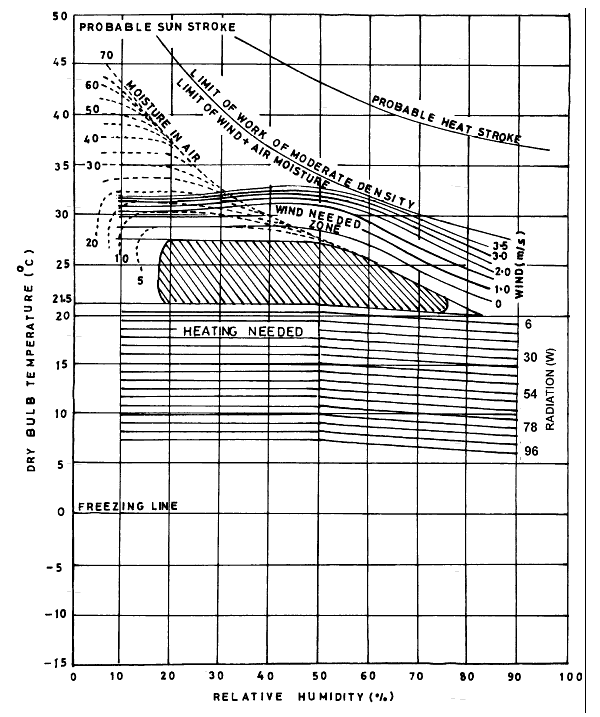
The chart plots dry-bulb temperature against relative humidity, with zones for mean radiant temperature, wind, solar radiation, and evaporative cooling. If a place’s temperature and humidity fall inside the comfort zone, conditions are comfortable.
Hot and dry
| Objectives | Physical manifestations |
|---|---|
| Decrease exposed surface area | Orientation and shape of building |
| Increase thermal resistance | Insulation of building envelope |
| Increase thermal capacity (time lag) | Massive structure |
| Increase buffer spaces | Air locks, lobbies, balconies, verandahs |
| Decrease air exchange by day | Weather stripping and scheduled air changes |
| Increase shading | Overhangs, fins, and trees |
| Increase surface reflectivity | Pale colour, glazed china mosaic tiles |
| Ventilate appliances | Windows and exhausts |
| Increase night-time air exchange | Courtyards, wind towers, arrangement of openings |
| Increase humidity | Trees, water ponds, evaporative cooling |
Warm and humid
| Objectives | Physical manifestations |
|---|---|
| Decrease exposed surface area | Orientation and shape of building |
| Increase thermal resistance | Roof and wall insulation |
| Increase buffer spaces | Air locks, lobbies, balconies, verandahs |
| Increase shading | Overhangs, fins, and trees |
| Increase surface reflectivity | Pale colour, glazed china mosaic tiles |
| Ventilate appliances | Windows and exhausts |
| Increase air exchange throughout the day | Ventilated roofs, courtyards, wind towers, openings |
| Decrease humidity | Dehumidifiers / desiccant cooling |
Moderate
The moderate zone follows a similar pattern to warm-and-humid: limit heat gain through orientation, insulation, buffers, shading, and pale surfaces; promote heat loss with ventilation, courtyards, and wind towers; and reduce humidity where needed.
Cold (cloudy and sunny)
| Objectives | Physical manifestations |
|---|---|
| Decrease exposed surface area | Orientation and shape; trees as wind barriers |
| Increase thermal resistance | Roof and wall insulation, double glazing |
| Increase thermal capacity | Thicker walls |
| Increase buffer spaces | Air locks, lobbies, balconies, verandahs |
| Decrease daytime air exchange | Weather stripping and scheduled air changes |
| Increase shading of unwanted surfaces | Overhangs, fins, and trees |
| Increase surface reflectivity where useful | Pale colour, mosaic tiles |
| Promote heat gain | South openings; courtyards and wind towers arranged for winter sun |
| Increase humidity | Trees, water ponds, evaporative cooling |
Composite
Resist heat gain in summer and heat loss in winter: compact form, insulation, thermal mass, buffers, weather stripping, shading, and pale surfaces. Promote heat loss in summer and monsoon with exhausts, courtyards, and wind towers. Raise humidity in dry summer (trees and ponds); lower it in monsoon (dehumidifiers).
Macroclimate and microclimate
Energy transfer through fabric, and people’s thermal response, are local and site-specific. These conditions are the microclimate: wind, radiation, temperature, and humidity around a building. A building changes that microclimate by obstructing wind and casting shadows. A designer has to predict the variation. Factors include landform, vegetation, water bodies, street width and orientation, and the relationship of open space to built form.
Illustrative example: Jodhpur
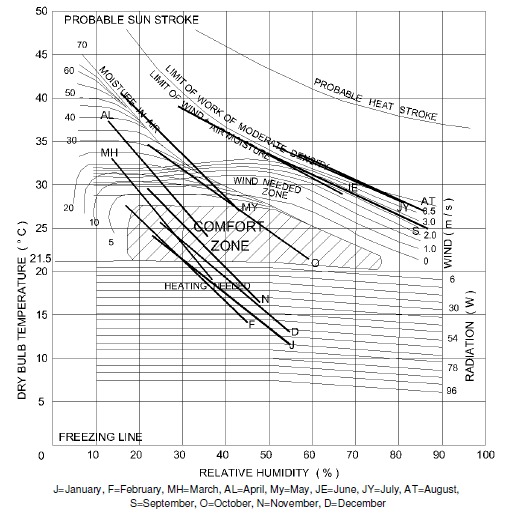
Inferences from the chart:
- Evaporative cooling is desirable in April and May.
- Mechanical air-conditioning is required from June to August because of high humidity with high temperatures.
- September is relatively cooler; ventilation may be enough for comfort.
- Evaporative cooling is desirable by day in October.
- Daytime conditions are comfortable in January, February, November, and December; nights are cool.
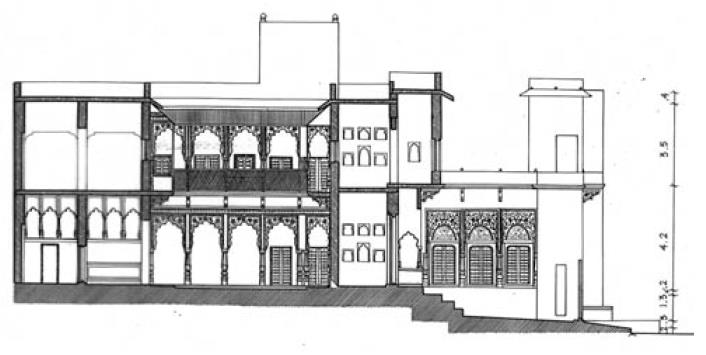
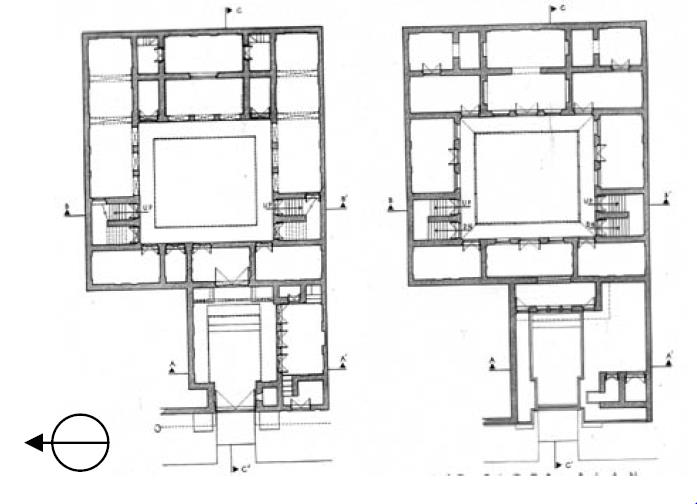
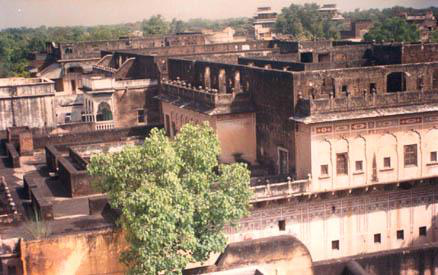
Haveli design at Jodhpur
Climatic features of the type:
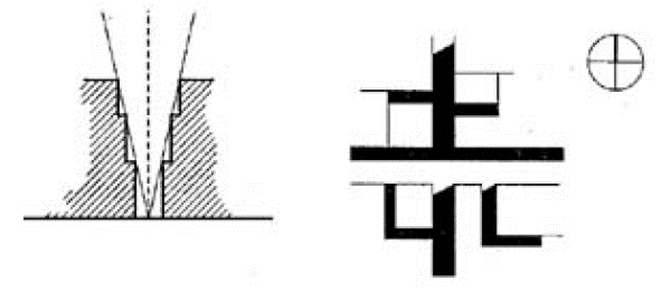
- Compact settlement plan
- Narrow streets with tall buildings
- Courtyard planning
- Heavy structure
- Shaded colonnades and semi-open areas
- Flat roofs with an insulation layer
- Small openings with thick shutters and jali screens
- Wind towers
Cold climate
- Locate buildings on the south slope of a hill for heat gain.
- Choose parts of the site that offer a natural wind barrier.
- Cluster buildings to minimise exposure to cold winds.
- Orient streets east–west so south sun can enter; make them wide enough that buildings do not shade one another.
- Place windows on the south façade; insulate the north. Put living rooms south and stores north.
- A sufficiently sloping roof drains rain and snow quickly.
- Skylights admit heat and light in winter; shutters avoid overheating in summer.
References
- Chapter 2, Journal of Ministry of New and Renewable Energy.
- Avlokita Agrawal and Prof. R. K. Jain (2006), Shekhawati: urbanism in the semi-desert of India. A climatic study.
- Krishna Jahwar (2009), High Performance Building for cold climate.